
Capillary drying
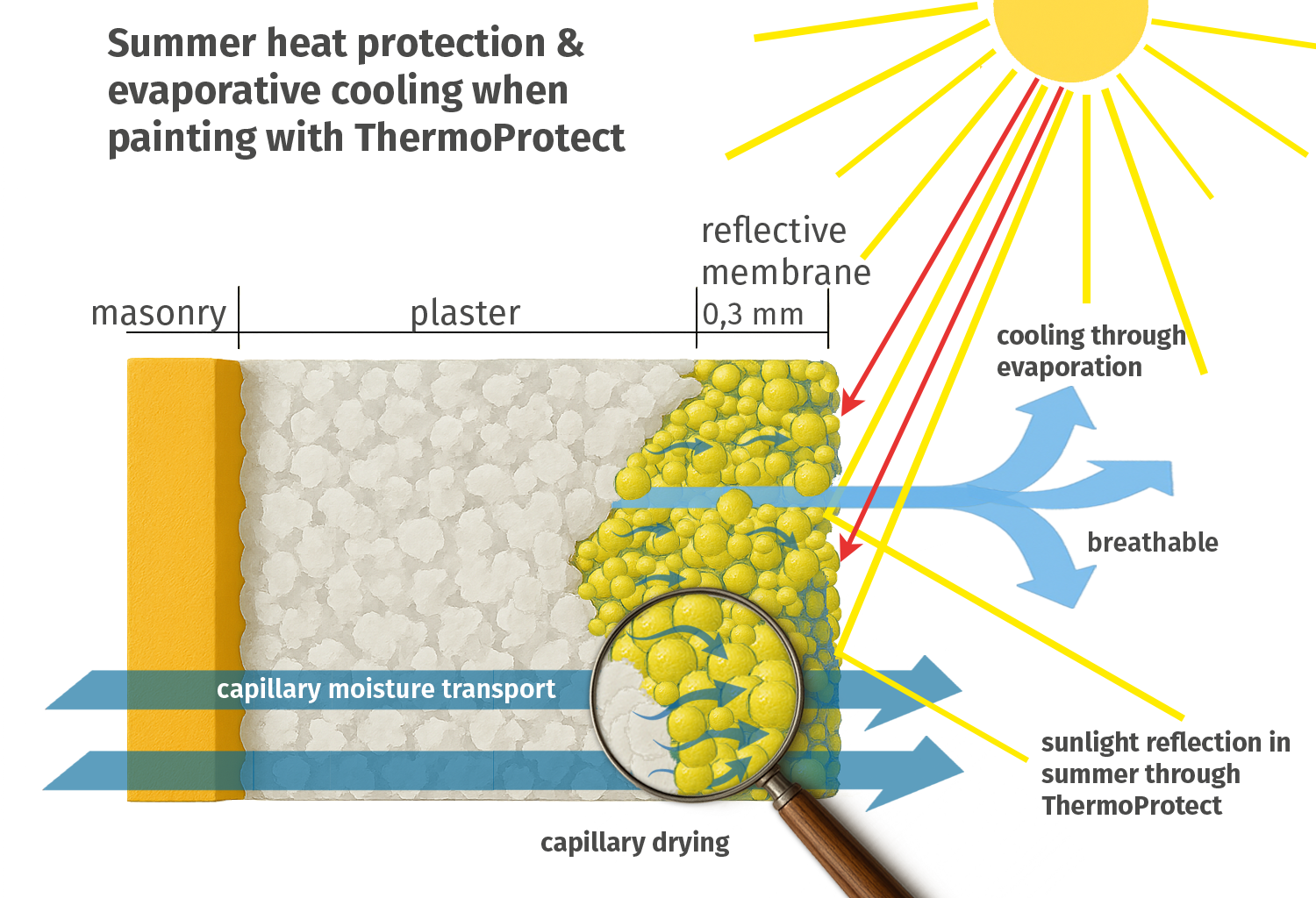
Capillarity refers to the behavior of liquids in capillaries, also known as hair tubes. If the adhesive forces between the liquid and the capillary wall are greater than the cohesive forces between the molecules of the liquid, the liquid “creeps” into the capillary, even against the force of gravity and all the more so the narrower the capillaries are / become. If this process transports liquid from the material (e.g. masonry) to the surface, where it then evaporates, this is referred to as capillary drying. The external render has a finer capillary system than the masonry, the reflective membrane has a finer capillary system than the external render. This creates directional transportation, resulting in drier walls.
Convection currents
The term convection comes from the late Latin convectio, which can be translated as ‘to bring’, ‘to carry along’. In this context, the term refers to a physical flow movement that takes place within a gaseous medium (fluid) and also to the phenomenon that the smallest particles in a flow carry energy with them, such as thermal energy. Convection currents can occur when air in the lower part of a living space is heated by a heater, creating a temperature difference between the top and bottom.
The warm parts flowing upwards cool down here and sink back down again. This creates a convection flow. This process takes place both inside and outside on the walls. Heat is transferred internally to the wall surface and externally to the ambient air.
Endothermic processes
Synonym for processes that take place in ClimateCoating® coatings, which proceed differently depending on external influences such as temperature and humidity. In chemistry, endothermic means that energy is absorbed or gained.
Entropy
Entropy must be thought of as a quantity-like quantity (energy content) that can flow or be contained in bodies: Of two otherwise identical bodies, the one whose temperature is higher contains more entropy. If two bodies of different temperatures are in contact with each other, entropy flows from the warmer to the colder body; as a result, the temperatures of the two bodies also equalize.
(Source: Wikipedia)
Fogging
Deposition of dark particles (black dust) on interior walls. In severe cases, the impression of sooting is created. The causes have not yet been clarified. However, as this effect occurs more frequently during the heating period, it is assumed that deposits of low-volatility organic compounds (so-called plasticizers) and other emitters are swirled around by convection currents (see: Convection currents) and settle on walls and ceilings.
Glass ceramic hollow bodies
Hollow glass-ceramic beads are tiny, vacuum-filled glass-ceramic beads that are used in special coatings to form a so-called “reflective membrane”. They have a diameter of only a few micrometers. Depending on the type and formulation (diameter), there are between 800,000 and 1.2 million hollow particles per square meter in the coating.
They are added to coatings, paints or plasters in order to specifically improve their physical properties. Thanks to their structure – a solid, smooth outer shell and an air or vacuum-filled interior – they make a significant contribution to reflecting heat radiation, reducing heat loss and optimizing the energy efficiency of buildings.
Hygrische Diode
The term diode in the conventional sense: The diode (Greek: di, ‘two’, ‘double’; hodos ‘path’) is an electronic component with two poles. The term diode is used as a synonym for the term “uncontrolled rectifier”. A hygric diode is, for example, a membrane that has a limiting effect on water transport. The water transport is rectified (one-way street) as the water can only pass the hygric diode in one direction. The hygric diode can therefore be compared to a mechanical non-return valve, as this only allows mass flow in one direction.
IR reflection
IR is the non-visible part of long-wave thermal radiation between visible light and microwaves. The wavelengths of the IR are 780 nm to 1,000 µm. The range from 3 to 50 µm is referred to as MIR (mid IR) as part of IR-C. Of these, the range from 9.25 to 11.45 µm is relevant, which corresponds to temperatures from +40 to -20°C. Thermal radiation is absorbed and reflected by opaque components (A + R = 1). In the reflective membrane – in contrast to conventional paints – processes of optical physics (radiation physics) take place due to the hollow ceramic beads, which are simply referred to as IR reflection. The result is higher and more even surface temperatures on the inside and reduced radiation losses on the outside – in other words, greater thermal comfort and lower heating energy requirements.
Light reference limit values
The light reference value is the degree of reflection of a certain color tone between black = 0 and white = 100. It indicates how far away the respective color tone is from the black or white point in its brightness. In color fans, the lightness value is indicated next to the color number. Neither the gloss level nor the binder used are decisive for the lightness value, but only the type and level of colored pigmentation.
Reflective membrane
… is the general term for a high-quality dispersion, enriched with hollow ceramic spheres and activators measuring just 20-120 micrometers, which – in combination with monolithic masonry – triggers complex, mutually dependent processes in building physics. These have a positive effect on moisture and heat transport and therefore on the energy balance.
Reflective membrane technology
The term describes the mode of action of the coating, which contains specially developed glass-ceramic hollow bodies that enclose a vacuum. These hollow glass-ceramic particles are combined with an extremely adhesive, specially developed dispersion and selected activators. After application, i.e. after application to the substrate, the coating forms a so-called reflective membrane. One could also speak of a “breathable skin”, to make an understandable comparison.
The effect and advantages of the coating are based on these building physics processes: Sunlight reflection, directed evaporation through capillary action, heat distribution and anti-electrostatic properties.
The diagram shows the physical processes of evaporative cooling through capillary moisture transport and the reflection of sunlight (summer heat protection).
Summer thermal insulation
Summer thermal insulation comprises structural and technical measures to prevent the heating of interior spaces by solar radiation. It is mandatory in the German building industry in accordance with the Building Energy Act (GEG) and DIN 4108-2. Important measures include efficient sun protection systems (preferably external), optimized building and window planning (e.g. smaller window areas and a lower total energy transmittance), effective night ventilation, the use of heat-storing building materials for delayed heat dissipation and the use of passive cooling depending on the type of building.
Summer thermal insulation ensures that interior rooms remain at a pleasant temperature even in strong sunlight. It prevents overheating, particularly in rooms with large windows or insufficient shading, and thus contributes to greater living comfort. At the same time, it reduces the energy requirement for air conditioning systems and supports the energy-efficient use of buildings.
Thermal bridges
A thermal bridge (often colloquially referred to as a cold bridge) is an area in the components of a building through which heat is transported to the outside faster than through the adjacent components. A distinction is made between constructive and geometric thermal bridges. Structural thermal bridges are caused by constructions with materials of different thermal conductivity. Examples of this are reinforced concrete ceiling connections to external walls, ring beams or radiator niches.
Geometric thermal bridges occur when the inner surface is not the same as the outer surface, for example due to offsets or corners in an otherwise homogeneous component. An example of this is the outside corner of the house, where the ratio of cold outer wall to warm inner wall is always greater.
(Source: Wikipedia)
Transmission heat transports/transmission heat losses
Transport of (thermal) energy between areas of different temperatures due to heat conduction in solid bodies such as the wall (the molecules collide with each other). The heat flow always flows from areas with higher energy to areas with lower energy, in this case: from warm to cold. The energy loss during this transport is also referred to as transmission heat loss. These are determined by the heat transfer coefficient. Other forms of energy transfer are convection and radiation. Transmission can be reduced by reducing radiation at the façade.
Variably open to diffusion
The vapor pressure of the air depends on the amount of water in the air and the temperature. As the temperature rises, the vapor pressure increases – we know this from the tea kettle, which whistles when the water is hot enough. Due to the humidity and temperatures, the vapor pressure is different inside and outside. The water vapor moves from high to low pressure and follows this gradient through the outer wall – it diffuses through it. In summer the vapor moves inwards, in winter it moves outwards. This is why external walls become damp in summer and dry in winter. The reflective membrane hinders the migration of water vapor into the interior of the building in summer and makes it easier for vapor to escape to the outside in winter. This property (variable permeability) makes the walls drier.
Winter thermal insulation
Winter thermal insulation serves to minimize heat loss in buildings and ensure a comfortable indoor climate by keeping the heat inside the building and preventing mould growth. This is achieved primarily through good thermal insulation of the façade, for example through external thermal insulation composite systems (ETICS), core insulation or monolithic construction methods. In addition, special façade paints can be used to protect the surfaces from moisture and the effects of the weather, thus indirectly contributing to thermal insulation. Further objectives are to protect the building fabric from moisture and climate damage and to comply with the legally prescribed minimum thermal insulation standards, which are based on DIN 4108.


