Residential house in Portugal 01

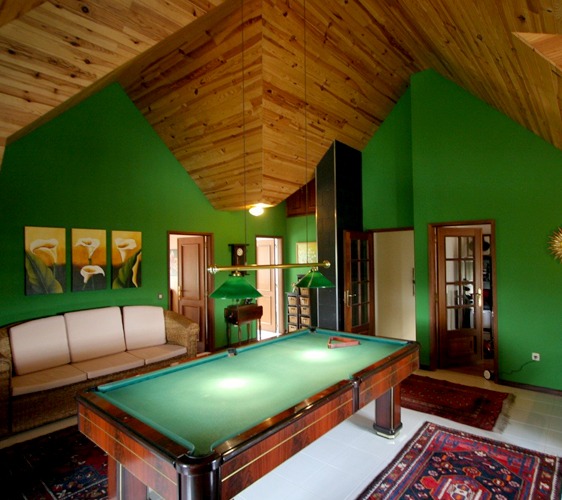
Residential house in Portugal

By painting the interior with ClimateCoating® ThermoPlus, the surface temperatures of the walls and ceilings were quickly raised and the room air and wall humidity were reduced.

Mr. Jean-Paul Drauth provided measurement results from his home, about 60 km south of Porto, in April 2008. On 26.03.2008 he painted the ceiling and on 30.03.2008 the walls were coated with ClimateCoating® ThermoPlus. The wall construction is as follows: Reinforced concrete stud construction with fired hollow clay bricks. Structure from inside to outside: plaster 1 cm/ hollow clay bricks fired with large chambers, 30 cm / external plaster 1 cm / adhesive 1 cm / clay brick slips 2 cm.

Mr Drauth describes the measurement procedure as follows: “Have been looking for an average value at the various points (not the highest / not the lowest) to get a meaningful measurement, this then again accurately aimed at the various measurements, where previously the measurements changed relatively strongly as soon as you deviated from the specific measuring point; this has leveled out very much! At the moment you can deviate more than half a meter from the measuring point without even a tenth of a degree changing in the display!”

The series of measurements again proves: ClimateCoating® raises the surface temperatures, and at the same time there is an equalization – the sensation temperature rises. In addition, the room humidity is regulated and the wall is dehumidified.

“I am a qualified heating engineer and have no problems calculating a U-value, but, the inertia of the mass is not taken into account anywhere, so with the climate and construction here it can happen more often, e.g. at 17°C or higher outside temperature and very high humidity; the occupants freeze as the outside temperature control switches off the heating circuit.” When thinking of Portugal, one rather thinks of beach, sun and plenty of heat – but: also in Portugal or Spain there are cold winters, depending on the region.

“I have a three-sided glazed veranda (conservatory) with ClimateCoating® on the ceiling since 13 March 2008, constantly have at least 3 degrees more than outside, no matter what the weather is outside, almost always the sliding door open because of the pets and a feeling of well-being like never before; in contrast: with all neighbours the chimney smokes!”

For the evaluation of the measurement results Mr. Drauth corresponded with a Berlin building expert. The question was the suitability of the U-value theory: “I can only agree with what you write regarding the U-value. Question: Why does one feel more comfortable with ClimateCoating® with less room temperature and yet the temperature curve in the wall construction should be worse than without? When painting half of the ceiling I already noticed the effect, it was definitely no longer a cold radiator. According to my measurements, you can already see that at least the contact resistance inside must be wrong, because I had surface temperatures equal to room temperature or even higher! This can’t be understood at all with the normal calculation method, and if I hadn’t measured myself, I would assume a measurement error.”

Nature vs Colours 01

Nature vs Colors

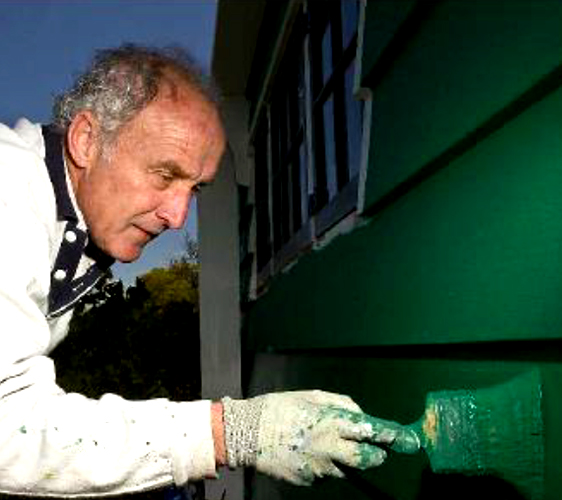
Practical experience proves the advantages of ClimateCoating® Nature.

ClimateCoating® Nature, that is the paint for components made of wood. To be precise: for non-dimensional components made of wood. This means that ClimateCoating® is not suitable for windows and doors because the thermoceramic membrane cannot withstand the mechanical stresses in the rebate, and it is also not used on running surfaces.

ClimateCoating® Nature shows its strengths on all other wooden components: Protection against UV radiation, sunlight reflection, driving rain protection, reduced swelling and shrinkage, dehumidification, diffusion openness, crack bridging, permanent elasticity. The prime example is the original Black ClimateCoating® house in Holland: after 15 years, no cracks, no blisters. This example has already been followed by several in black.

There is no need to denigrate other products for wood, the comparison in practice provides a good basis for deciding for or against a product. Sometimes a few pictures say more than many words. You can choose ClimateCoating® Nature in thousands of colour shades. They apply it: for wooden houses, half-timbered houses, roof boxes, fences.

Apartment block in The Hague 01

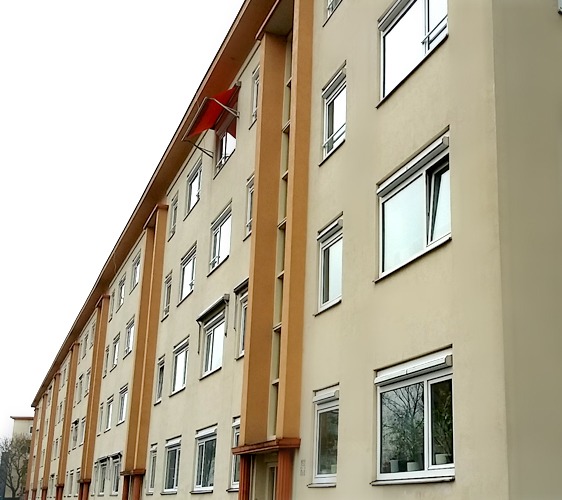
Apartment block in The Hague

With ClimateCoating® ThermoProtect: crack-free after 9 years on the facade

No official test was planned at the time, but practice often yields convincing results. The pictures show a residential complex in the Dedemsvaartweg in The Hague, Netherlands. The facades were painted in the spring of 2006 and on 25/02/2015 Mr. Henk van Leeuwen of Fa. Coateq is picking up the object of interest.

At that time, two different products were used: the facade paint ClimateCoating® ThermoProtect from SICC GmbH, Berlin, and the facade paint from a German market leader. After about 9 years, the surfaces were put under the microscope.

SICC GmbH claims as producer: “The high resistance to environmental stresses such as smog, acids, salts and ozone as well as to UV radiation ensures the high elasticity of ClimateCoating® Exterior and prevents cracking due to embrittlement or aging over a long period of time. Stress cracking is greatly reduced because the thermal protection offered by ClimateCoating® Exterior, due to its high content of ceramic hollow spheres embedded in a special binder, significantly reduces the different expansion movements of the building materials.”

The pictures prove her right, the practical test on the facade in outdoor weathering was also passed here: the coating is free of cracks after 9 years.

Stelling van Amsterdam 05

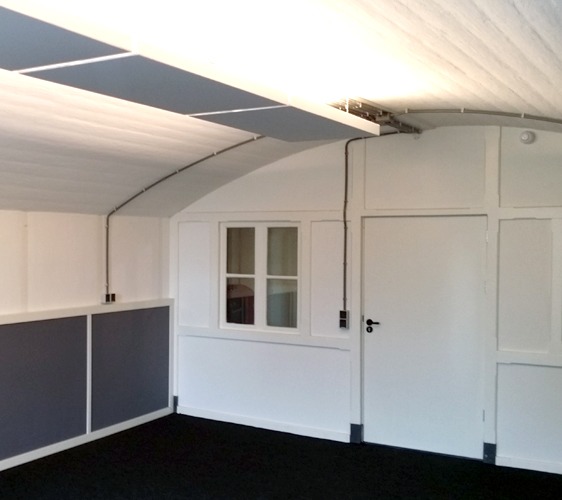
Stelling van Amsterdam

Increase of surface temperatures, reduction of noise

Fort St. Aagtendijk is part of the UNESCO World Heritage Site “De Stelling van Amsterdam”. ClimateCoating® ThermoPlus was applied on behalf of the organization “Stadsherstel NV”.

The old, smudge-proof coating was fixed beforehand. As a result of coating with ClimateCoating® Interior, the following effects were observed: less sound, better heat distribution and thus no more cold walls.

Residential house in Berlin after 6 years 01

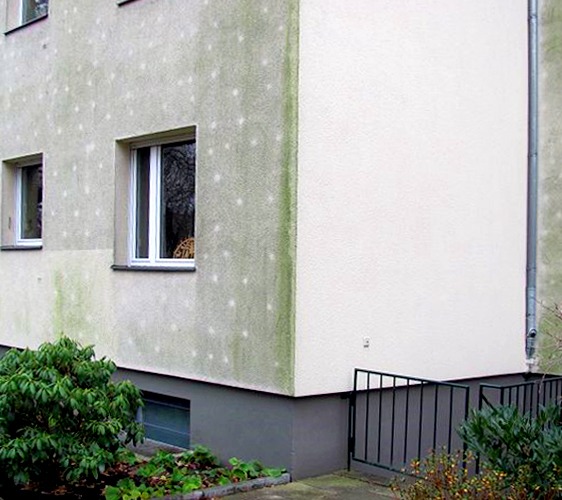
Residential house in Berlin after 6 years

Test surfaces on an insulated façade with a “premium façade paint” and ClimateCoating® ThermoProtect reveal major differences in quality

On 08.12.2009 a Berlin building expert inspected facades in the L.str. 56 in Berlin and on the neighbouring building on the left. This was a practical comparison of facade paints (outdoor weathering of the test surfaces after 6 years on the ETICS facade).

On the neighbouring building, a trial coat of the best facade paint from a market leader was applied to the offset gable. After 6 years there is a problem that cannot be overlooked: clearly pronounced cracks in the coating. The visibility of the cracks is possible without tools.

The facade paint of a market leader shown here is a “particularly dirt-resistant silicone resin facade paint with an outstanding binder-filler combination” with the properties “dirt-minimized, capillary-hydrophobic, mineral-matt, highly water-repellent”. Theory and practice seem to diverge somewhat here: with this crack pattern, the paint is rather not water-repellent. This clearly shows that the classification of an ETICS according to DIN 4108-3, Table 3, Line 6, to stress groups I to III with regard to driving rain protection is a theoretical, albeit standardized, assumption.

The comparison area at the gable of house no. 56 was – also 6 years ago – built by Fa. Karl from Berlin coated with ClimateCoating® ThermoProtect. The examination of the ClimateCoating® test surface showed a damage-free condition at different zoom levels and even under the façade magnifying glass. This facade coating clearly surpasses the result of the competitor after 6 years.

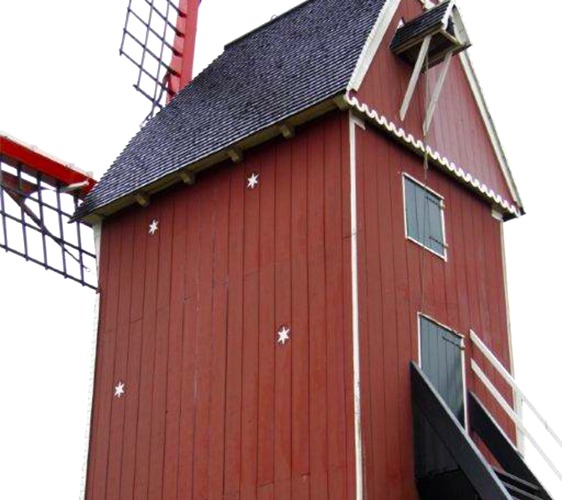
Nature for windmills 01

Nature for windmills

A facade renovation with ClimateCoating® Nature.

Holland – that is the canals in Amsterdam, cheese, bicycles. And windmills. Holland and its windmills are inseparable, they are one of the well-known symbols of the Netherlands. Dutch windmills appeared at the end of the 16th century, and there were 10,000 windmills in the Netherlands by the end of the 19th century.

Since the population has now shrunk to about 1,000, the preservation and maintenance of the existing windmills is important. ClimateCoating® Nature makes a good contribution to this. The good experiences with the Black ClimateCoating® houses provide the basis for the decision.