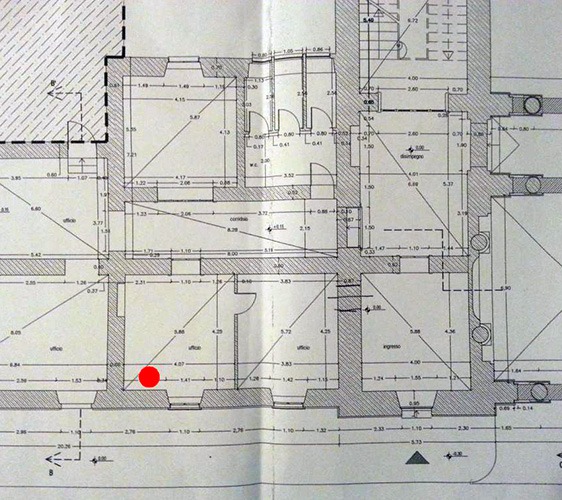
The heat flow measurement for Rome 01

The heat flow measurement to Rome

Winter 2015/2016

As is well known, it is deliberate mischief to re-measure a specimen coated with ClimateCoating® in the hotplate device, as there is no surface left with this method – no surface, no surface activity. Furthermore, in hotbox and climatic chamber experiments in the laboratory, experience has shown that miniaturization of the experimental set-up does not yield results.

Therefore, Italy has gone the way of carrying out a practical test with a very large hotbox. For this purpose, measurements were carried out in the period 11.12.2015 to 25.01.2016 at Via Merulana 121 in Rome. The building has walls made of tuff blocks with a thickness of 80 cm on the ground floor to 40 cm on the upper floors.

The “very large hotbox” was a room on the ground floor with a wall 80 cm thick. The heat flow meter 435-2 from Testo was used for the in situ measurement of the heat permeability before and after the application of the product ClimateCoating® ThermoProtect. Long before the measurement, a calculation of the improvement in the thermal insulation properties of the wall was carried out using the calculus tool Calculus with the ClimateCoating® fTS calculation values.

The test led to the following conclusions: The heat flow measurements carried out confirmed the calculation from July 2015 with a good approximation of the data. An improvement of the equivalent U-value by 33% was calculated. A change in thermal conductivity from 0.71 to 0.48 W/mK was measured. This corresponds to 32%.

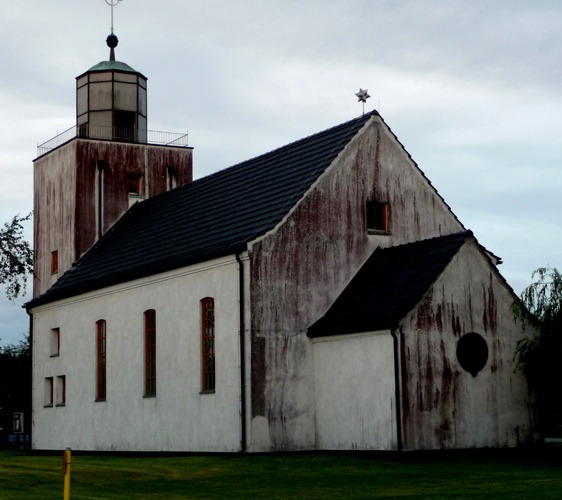
St. Peter's Church in Mönkebude 01

St. Peter’s Church in Mönkebude

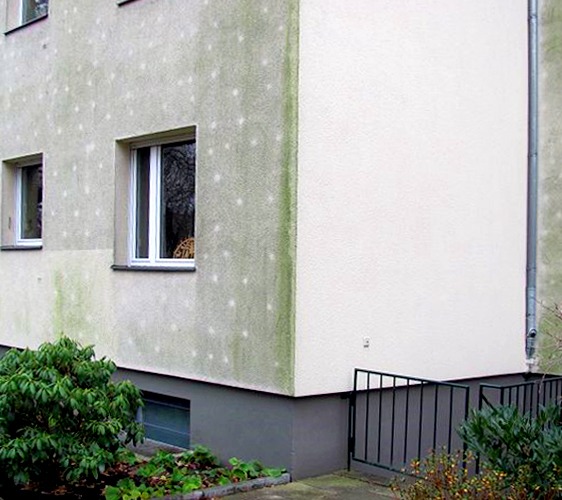
The façade of St. Petri’s Church in Mönkebude was becoming increasingly discoloured due to increasing red algae infestation. Following a structural measure on the vestibule, it was painted white with ClimateCoating® ThermoProtect for testing in spring 2013. After three years of trial painting without complaint, the refurbishment of the entire façade was commissioned in July 2016. The church facade surfaces were cleaned and treated with an algicide. (according to the decision of the master painter, not with the Brügmann red algae facade cleaner recommended for red algae). In August 2016, the facade surfaces were coated with ClimateCoating® ThermoProtect white. Since then, the facade view has been flawless. (as of September 2021)

Key data:

Object/Building Type: Church St. Petri Mönkebude
Builder/Client: Protestant parishes
Altwigshagen, Leopoldshagen, Mönkebude
Evang. Rectory
Mr Shield
www.kirche-mv.de
Location of the object: Lübser Landstraße 31
17375 Mönkebude
Germany
Architects/Planners: Architect’s office Hans Giger
Str. der Einheit 74 A
17379 Wilhelmsburg
Color design: Parish Council
Execution/Processor: Master painter S. Scheel
Str.d.Freundschaft 34
17379 Wilhelmsburg
www.malermeister-scheel.de
Products used: Facade 550m2
ClimateCoating®® Exterior white
Execution Date: August 2016
Consultant/Service Partner: Borgwardt Industrial Representation
Mrs D. Borgwardt
Ring road 40
17373 Ueckermünde
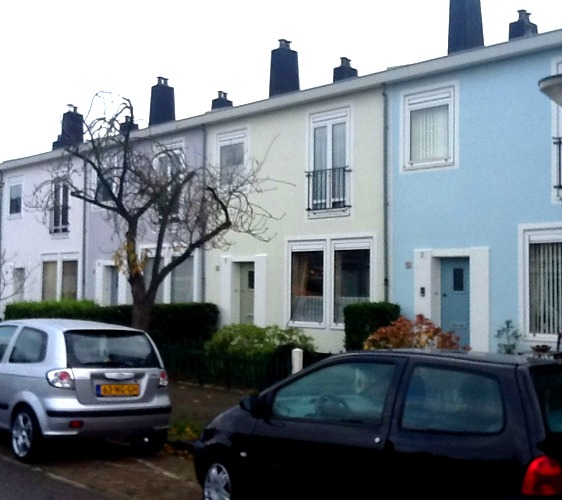
Terraced houses in the Netherlands 01

Terraced houses in the Netherlands

Just over 5% energy saving

In addition to a good and stable appearance over many years as well as weather protection, a ClimateCoating® coating of the facade also results in savings in heating energy. These vary depending on the wall material and building type. For these terraced houses in Ymere, the Netherlands, it was over 5% after coating in 2011. This is nothing special, one might think – in the comparable building with 3 cm polystyrene insulation it has not been much more since 1990. The special feature here lies in the relation of the enveloping surface shares of outer wall to roof and windows.

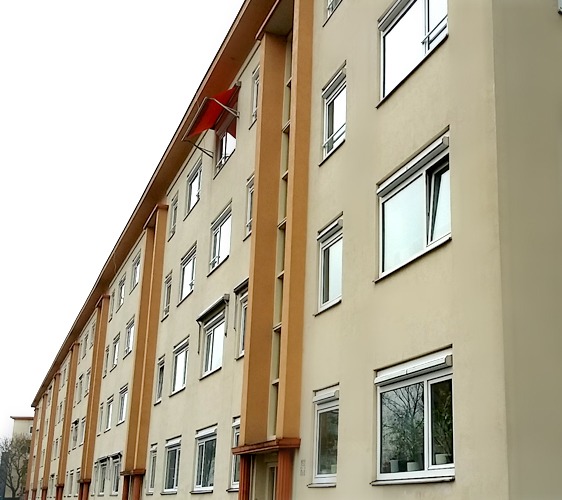
Apartment block in The Hague 01

Apartment block in The Hague

With ClimateCoating® ThermoProtect: crack-free after 9 years on the facade

No official test was planned at the time, but practice often yields convincing results. The pictures show a residential complex in the Dedemsvaartweg in The Hague, Netherlands. The facades were painted in the spring of 2006 and on 25/02/2015 Mr. Henk van Leeuwen of Fa. Coateq is picking up the object of interest.

At that time, two different products were used: the facade paint ClimateCoating® ThermoProtect from SICC GmbH, Berlin, and the facade paint from a German market leader. After about 9 years, the surfaces were put under the microscope.

SICC GmbH claims as producer: “The high resistance to environmental stresses such as smog, acids, salts and ozone as well as to UV radiation ensures the high elasticity of ClimateCoating® Exterior and prevents cracking due to embrittlement or aging over a long period of time. Stress cracking is greatly reduced because the thermal protection offered by ClimateCoating® Exterior, due to its high content of ceramic hollow spheres embedded in a special binder, significantly reduces the different expansion movements of the building materials.”

The pictures prove her right, the practical test on the facade in outdoor weathering was also passed here: the coating is free of cracks after 9 years.

Residential house in Berlin after 6 years 01

Residential house in Berlin after 6 years

Test surfaces on an insulated façade with a “premium façade paint” and ClimateCoating® ThermoProtect reveal major differences in quality

On 08.12.2009 a Berlin building expert inspected facades in the L.str. 56 in Berlin and on the neighbouring building on the left. This was a practical comparison of facade paints (outdoor weathering of the test surfaces after 6 years on the ETICS facade).

On the neighbouring building, a trial coat of the best facade paint from a market leader was applied to the offset gable. After 6 years there is a problem that cannot be overlooked: clearly pronounced cracks in the coating. The visibility of the cracks is possible without tools.

The facade paint of a market leader shown here is a “particularly dirt-resistant silicone resin facade paint with an outstanding binder-filler combination” with the properties “dirt-minimized, capillary-hydrophobic, mineral-matt, highly water-repellent”. Theory and practice seem to diverge somewhat here: with this crack pattern, the paint is rather not water-repellent. This clearly shows that the classification of an ETICS according to DIN 4108-3, Table 3, Line 6, to stress groups I to III with regard to driving rain protection is a theoretical, albeit standardized, assumption.

The comparison area at the gable of house no. 56 was – also 6 years ago – built by Fa. Karl from Berlin coated with ClimateCoating® ThermoProtect. The examination of the ClimateCoating® test surface showed a damage-free condition at different zoom levels and even under the façade magnifying glass. This facade coating clearly surpasses the result of the competitor after 6 years.

Day care centre in Pankow 01

Day care centre in Pankow

Facade coating in 2004: ClimateCoating® ensures a beautiful building and a healthy climate at the St. Maria Magdalena day-care center for children

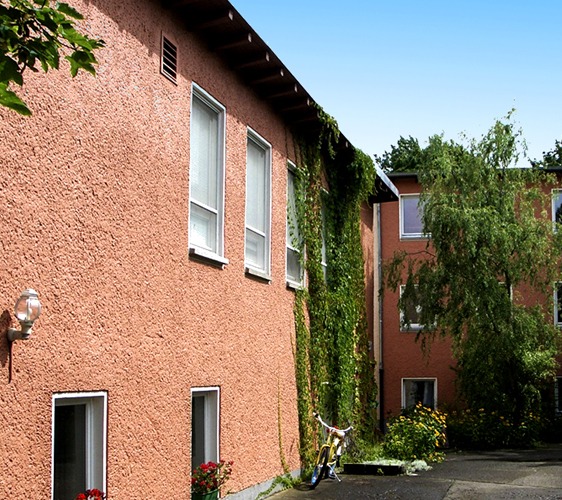
Berlin, August 9, 2004. While politicians are still discussing better funding for childcare, Berlin’s daycare centers are increasingly receiving support from the business community. The daycare center of the Catholic parish of St. Maria Magdalena in Pankow, for example, is pleased to celebrate its 10th birthday over a refurbished building. Thanks to the support of two Berlin companies, the formerly grey house at Boris-Pasternak-Weg 16-20, near Schönhausen Palace, will shine in a beautiful shade of terracotta for the big birthday summer festival on 29 August.

The main sponsor is the Berlin-based SICC GmbH, which is one of two companies worldwide that manufactures the innovative ClimateCoating® surface coating and distributes it exclusively in Germany, Europe and the Middle East. SICC GmbH provided around 1000 litres of its ClimateCoating® ThermoProtect product free of charge and financed the painting work. The company Hoffmann Gerüstbau provided the necessary scaffolding free of charge for the duration of the renovation work.

Thanks to ClimateCoating®, the approximately 70 children at the St. Maria Magdalena daycare center can now be cared for in an environment that is as beautiful as it is healthy. Because ClimateCoating® not only reduces annual heating costs by up to 30 percent, it also protects the building from mold, algae, cracks and environmental pollution. Thanks to an optimum humidity of around 55 percent and even heat distribution, a building coated with ClimateCoating® has a permanently healthy and pleasant feel-good climate, especially for children with allergies and asthma. And in the hot summer months, the rooms no longer heat up so unpleasantly.

“We parents are very happy that the kindergarten now looks so nice and that SICC GmbH is doing so much for our children,” explains the chairman of the parents’ association Wolf Dornblut. Ursula Erler from the building department of the archbishop’s office is also enthusiastic: “When the parish of St. Mary Magdalene took over the responsibility for the daycare center ten years ago, the rooms were renovated on the inside, but there was simply never any money for an exterior renovation. That’s why we were very pleased with the offer from SICC GmbH to renovate the daycare center free of charge.”

After approval by the responsible monument authority – the daycare center is located in the access road to Schönhausen Castle – construction work could begin at the start of the daycare center holidays at the beginning of July. Everything should be ready in time for the big summer festival on 29 August. On this day, children, parents, educators, community members and residents will celebrate the birthday and the completed renovation together with the employees of SICC GmbH and the company Hoffmann Gerüstbau. Interested visitors are cordially invited. “This project has been a lot of fun for us and we will certainly continue to work in this direction,” said SICC Managing Director Waldemar Walczok. “After all, our children are the most important thing we have.”